Line Striping & Pavement Markings

Line Striping and Pavement Marking Services for Parking Lots and Roadways That Require Clear Layouts, Organized Traffic Flow, and Compliance with Safety and Accessibility Standards

Clear pavement markings are essential for safety, organization, and proper use of any paved surface. At Huff General Engineering, we provide line striping and pavement marking services for commercial properties, parking lots, and roadways. Well-defined markings help guide traffic, designate parking spaces, and ensure compliance with local regulations. Faded or poorly marked surfaces create confusion, reduce efficiency, and increase the risk of accidents.

REQUEST A QUOTE

Submit the form below and one of our estimators will get back to you shortly.
*We respect your privacy and will not share your information.

What Good Striping Does for a Property

Striping is the last thing applied to a lot and the first thing people notice. Fresh, accurate lines make a property look maintained, but their real job is functional: they control how hundreds of vehicles move through the same space every day.

A good layout balances stall count against safe circulation and keeps fire and emergency access open. It places accessible parking where it connects to the building entrance and gives delivery trucks room to load without blocking traffic. Proper spacing, alignment and visibility are what make a parking area function on a daily basis, and getting them wrong shows up quickly as tight stalls, dinged doors and drivers cutting across aisles.

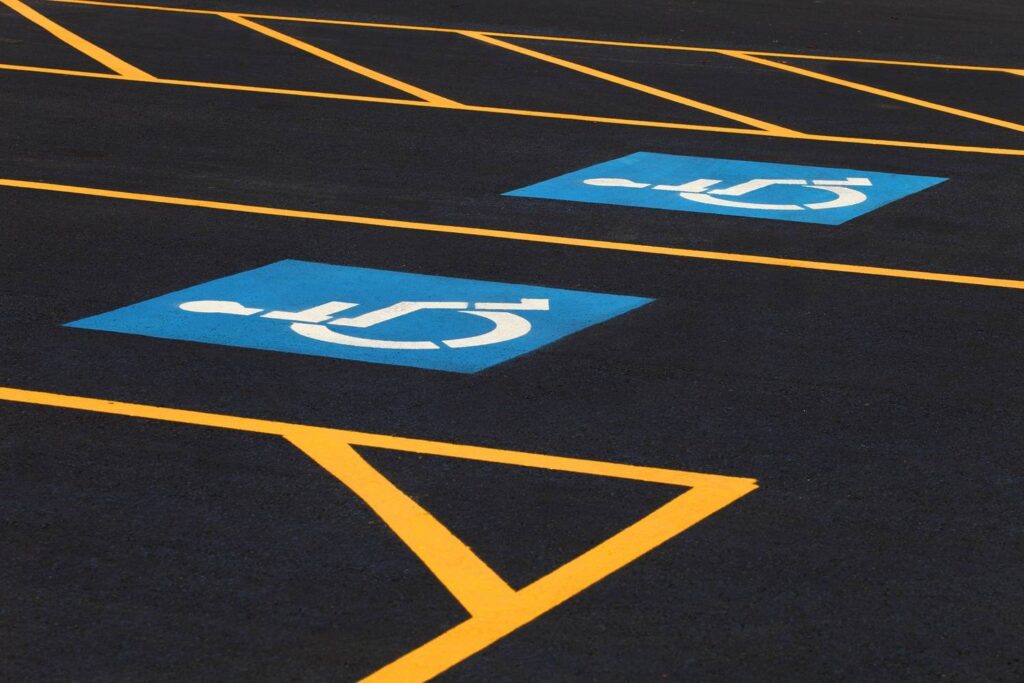
Accessible parking also carries specific state rules. In California, the Building Code requires each accessible parking access aisle to have the words “NO PARKING” painted on its surface in large white letters visible from the drive aisle, along with markings that clearly identify the accessible space itself. These details are easy to miss on a quick restripe, and we lay them out carefully every time.

Striping and Marking Services

  • Parking lot striping and restriping: Standard stalls, compact spaces, end lines and stall numbers, applied consistently so they stay visible under regular traffic.
  • Accessible parking markings: Accessible stalls, van-accessible spaces and access aisles with the required symbols, hatching and “NO PARKING” lettering.
  • Fire lanes and curb painting: Fire lane stenciling and colored curbs following California’s curb color system, such as red for no stopping, blue for accessible parking and yellow or white for loading zones.
  • Directional markings: Arrows, stop bars, crosswalks, “STOP” and “SLOW” legends that guide drivers and pedestrians through the site.
  • Loading zones and special-use spaces: Loading areas, EV charging spaces, reserved, visitor and pickup stalls, marked so they are clear at a glance.
  • Private road and HOA markings: Center lines, edge lines, stop bars, crosswalks and speed hump markings for community streets and private roads. The construction side is covered on our private road and laneway paving page.
  • Layout changes: When existing markings are no longer accurate or need updating, we redesign the layout to suit current use, whether that means adding stalls, rearranging traffic flow or bringing accessible parking up to date.

How We Stripe a Property

  1. Review the layout: We look at the current markings, how traffic actually moves, where the entrances, fire access and accessible routes are, and whether the layout needs changes or a straight restripe.
  2. Prepare the surface: The pavement must be clean and free of debris for proper adhesion, so the surface is swept and blown off, and any cracks or damage are addressed before paint goes down.
  3. Remove or cover old lines: When the layout changes, old markings are removed or blacked out so drivers are not left guessing between two sets of lines.
  4. Lay out the design: Stall widths, angles and aisle spacing are measured and marked on the pavement before striping begins, so the finished lines are straight and evenly spaced.
  5. Apply the markings: Durable striping material is applied with a striping machine for lines and with stencils for symbols, arrows and lettering, at a consistent width and coverage.
  6. Cure and reopen: Each area stays closed until the markings are dry enough for traffic, and work is sequenced so the property keeps access during the job.

Signs It Is Time to Restripe

  • Lines faded enough that drivers park unevenly or across two stalls
  • Accessible stalls or access aisles that are hard to identify
  • Fire lanes and red curbs that have worn away
  • Arrows and crosswalks that are no longer visible, especially at night
  • Tenant or customer complaints about confusing traffic flow
  • A recent sealcoat or paving project that covered the old lines
  • A change in how the lot is used, such as new tenants, EV chargers or added loading space

Faded markings are not just a cosmetic problem. Unclear fire lanes and accessible spaces can create liability for the property owner.

Planning Your Striping Schedule

Striping needs dry pavement and mild weather to bond and cure. In Northern California, most work happens outside of rain events, with the dry months offering the most dependable window. Markings on busy commercial lots wear faster than those on quiet residential roads, so restriping frequency depends on traffic volume, sun exposure and how often the surface is swept or plowed.

The most efficient timing is right after maintenance. Restriping is commonly completed after sealcoating or a new parking lot paving project to restore visibility and maintain organization, once the new surface has cured enough to take paint. On commercial properties, work is often scheduled during lower-traffic hours or in sections so businesses can stay open.

Why Property Managers Choose Huff General Engineering for Striping

  • Layouts that work: We plan markings around how the property is actually used, not just where the old lines were.
  • Attention to accessibility details: Accessible stalls, aisles and lettering are laid out with care so the site is not left with avoidable compliance gaps.
  • One team for the whole surface: Repair, sealcoating and striping are handled by the same company, so the lot is fixed, protected and marked in one coordinated sequence.
  • Experience on every kind of pavement: Under owner Michael Huffaker, our crews work on everything from estate entrances to busy commercial lots, and that range shows in clean, accurate lines.

Where We Provide Line Striping

We stripe parking lots, HOA streets and commercial sites in Concord, Walnut Creek, Pleasant Hill, Martinez, Dublin, San Ramon and Danville, plus properties elsewhere in our service area toward Sacramento.

Line Striping FAQ

How often should a parking lot be restriped?

It depends on traffic, weather and maintenance. High-traffic lots and drive aisles wear faster, while quieter lots hold their lines longer. Most owners restripe whenever the lot is sealcoated, and in between whenever markings start to fade.

Can you change the layout of my parking lot?

Yes. We can add stalls, rearrange traffic flow, add EV or loading spaces and update accessible parking. Old lines are removed or covered so the new layout reads clearly.

What markings are required for accessible parking in California?

Accessible spaces must be clearly identified, and each access aisle needs “NO PARKING” painted on its surface in white letters, along with markings that discourage parking in it. Signage and slope requirements also apply, so for a full compliance review, a certified accessibility specialist can assess the site.

How long before cars can drive on new striping?

It depends on the material and the weather while it dries. We keep each section closed until the markings are ready and reopen the lot in stages so access is maintained.

What affects the cost of line striping?

Line striping costs are shaped by:

  • The size of the lot
  • The number of stalls and symbols
  • Layout changes or removal of old lines
  • Accessible parking and fire lane work
  • Curb painting
  • Surface preparation
  • Phasing requirements

A written quote follows our review of the property.
Get Your Property Striped Right

Send over the details of your property and one of our estimators will get back to you shortly. Property managers handling multiple sites can call 925-360-0984, Monday through Sunday, 7:00 AM to 8:00 PM, to plan the work.

Request My Free Estimate

Huff General Engineering, Walnut Creek, CA. Serving the Bay Area and the Sacramento corridor. 925-360-0984